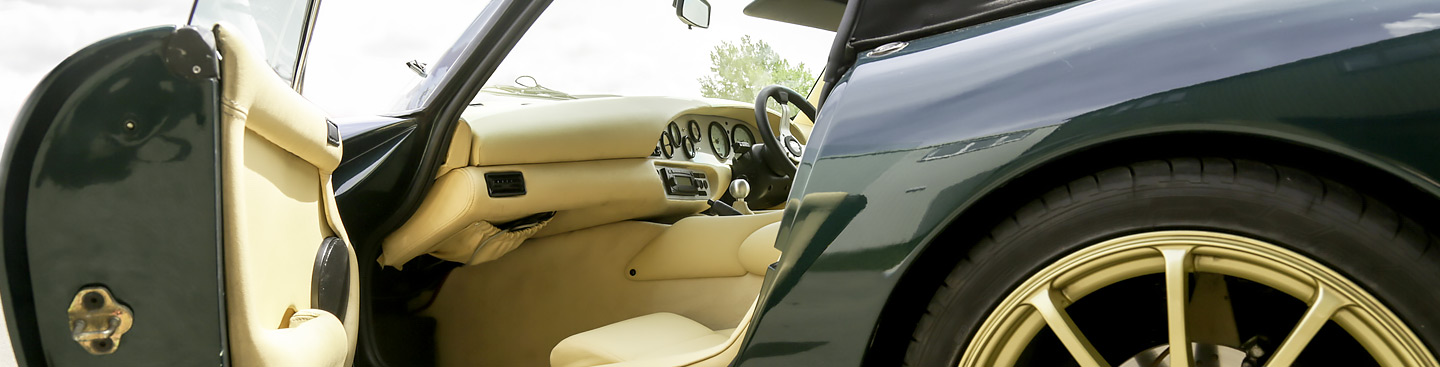
TVR Chimaera 400 HC

At Lloyd Specialist Developments we love cars like the TVR Chimaera, all the main ingredients are already there but there is still a massive scope for further development.
Purchase
With this in mind we purchased a late 1995 TVR Chimaera in need of some TLC but in fundamentally sound order (chassis and engine block both in reasonable condition). This came with the later T5 gearbox and 4 litre serpentine Rover V8 engine with the higher lift camshaft common to the 5 litre Chimaera.
When starting a development program on a vehicle it is essential to establish the purpose for which you are developing that vehicle early on. This ensures that you get the best vehicle for the job and avoids spending excessive amounts of money. 
It was decided that this TVR is to be developed as the ultimate sports car for the open road, with performance to match the fastest cars on the roads today but with an effortless driveability to match modern luxury cars.
Some would argue that this is not possible, if it was surely TVR would have done it? We believe that this is a classic case of a car that, whilst still being great in its own right, is seriously under-developed. We hope to prove those doubters wrong and in the process design and manufacture some fantastic parts for your TVR Chimaera and Griffith, so watch this space...
Camshaft Replacement
Having done approx. 70,000 miles, the camshaft sounded worn so we decided to firstly fit a new cam. It is unclear as to exactly which camshaft was fitted to the 400 HC model so we decided to spec. a camshaft from scratch, using our engine simulation software. V8 Developments have a good reputation with regards to cams but were unable to provide us with camshaft data, so it was a choice between a range of Kent and Piper camshafts. Our research concluded that the Kent H218 provided the best all-round performance (good performance, broad power-band, etc) with our particular engine specification. When ordering this camshaft from Kent we were told that this cam was a 'down-grade' (i.e.: less lift) from our previous camshaft but we ordered it anyway, now with a little trepidation!
When we removed the old camshaft it was clear that we were not a moment too soon, the 5th lobe was providing a mere 2.4mm of lift! Many of the others were almost as bad, with a range of 5.9mm across the lobes, this indicates that the high-lift camshafts fitted to some of these TVRs have a particularly short life-span. This TVR was certainly not providing anywhere near the performance it should have been, if you have a Rover V8 engined TVR we would definitely recommend checking that your camshaft is not badly worn before spending money on any other engine upgrades.
For general information the camshaft that we removed had the following number stamped on it: KC TVR 435RM 11932 116 and it was ground out of a 22mm blank rather than a 26mm blank. Whilst we were there we re-conditioned the cylinder heads, added a camshaft thrust-plate (did not have one fitted as standard?!) and replaced all of the timing gear. When fitting our new camshaft we fitted the single valve springs, rather than double valve springs, as we were not building the engine to rev over 6000rpm and the increased valve spring pressure from double valve springs would only increase valve-train wear.
The rocker gear was also extremely worn, with broken contact pads on two of the rockers! These were replaced with Federal-Mogul steel rockers, capable of operating up to 7000rpm.
Once we had completed our work, it was time for a test drive. The difference was impressive, like we had just put a bigger engine in there! It felt as though the torque was everywhere, from 1500rpm all the way to 6000rpm.
Fully Programmable Engine Management
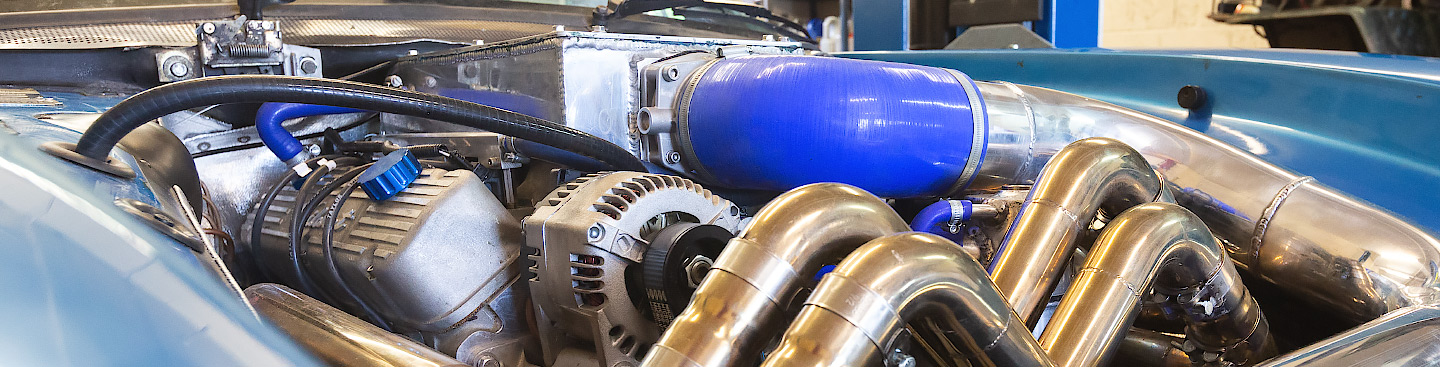
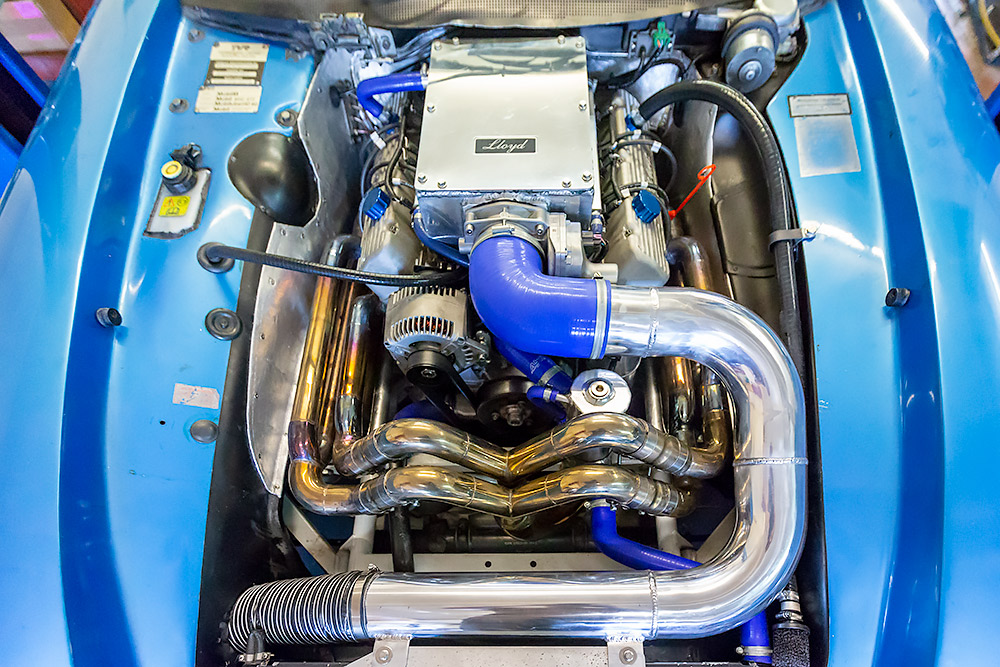
This was good but when fine-tuning the engine at different conditions we kept finding that we were handicapped by the lack of adjustability in the Lucas 14CUX fuel injection system and the antiquated distributor system. Therefore we decided to develop and fit a complete engine management kit for the Rover V8, including a fully mappable ignition system. Unfortunately this was not a simple case of purchasing and wiring in an after-market ECU, as the Rover V8 does not have all of the required hard-ware for such a system. It also involved sourcing and fitting a trigger wheel, crank sensor, screened cable and coil-packs, as well as making our own sub-looms, ECU bracket and coil-pack bracket. We also needed to integrate this all with our current system, with our stepper motor idle control and coil-driven tachometer. 
Completing this job involved the removal of the restrictive mass air flow meter, so a custom air intake had to also be made. This was done using a length of stainless steel tube that we already had in our steel stock, as well as a K&N air-filter.
After an initial set-up, the car was placed on the rolling road to fully map the engine management system. The rolling road is a particularly useful tool when mapping the ignition system. After a few hours we had mapped the car at a very respectable 241 BHP and 275 lb ft. This was with no less than 250 lb ft between 2000 and 5000rpm! To drive, the car felt like no other 4 litre TVR that we had previously driven, with even more torque than ever and very, very smooth. Like this it is able to pull away in any gear, as well as start and run smoothly without any problems in any weather. When left for a few days, the TVR used to always run poorly for at least 15 minutes. Now it always fires up instantly, and runs smoothly straight away. This Engine Management Kit is exactly what many Rover V8 engines need - providing reliable, waterproof mappable ignition performance. See DIS Engine Management - Rover V8 for more information on the differences between distributor and distributor-less systems on the Rover V8.
Current Performance
0-60mph = 4.7 seconds
Peak Horsepower = 241 BHP (Measured using Dyno Dynamics rolling road)
Peak Torque = 275 lb ft (Measured using Dyno Dynamics rolling road)